
Inside the Longevity Supplement Market: A Scientific Scorecard
We scored TimeWarp Longevity Protocol against five leading longevity supplements across 15 dimensions. Most of them aren't close.
The longevity supplement market has a credibility problem. Dozens of brands now claim to "target all 12 hallmarks of aging" — a phrase that has become the industry's favorite shorthand for scientific legitimacy. But when you pull apart the actual formulations, most of these claims collapse under scrutiny: sub-therapeutic doses dressed up with clinical-sounding language, redundant ingredients inflating label counts, and no architectural logic connecting the compounds into a coherent intervention.
We wanted to see how the leading longevity protocols actually compare — not on marketing, but on formulation science, systems design, and consumer value. So we built a 15-dimension scoring framework organized into three pillars and applied it to six products:
TimeWarp Protocol 01 — 25 unique ingredients across three daily capsule SKUs (Core, Energize, Protect) plus a monthly Senolytic Cleanse pulse. $250 one-time / $225 subscription with free shipping.
IM8 Daily Ultimate Longevity — 10 ingredients in a single daily powder sachet. An açaí pomegranate-flavored powder co-founded by David Beckham. $149 one-time / $119 subscription.
Novos Core — 14 ingredients delivered as a daily powder sachet. Positioned as an evidence-based longevity foundation with peer-reviewed lifespan extension data in aged mice. $109 one-time / $98 monthly sub / $93 6-month / $79 annual.
TallyHealth Full Stack (Vitality, Amplify, Restore, Sharpen, Defend, NAD+) — 21 unique ingredients spanning six separate SKUs and 14 daily capsules. Co-founded by David Sinclair. $454 one-time (~$386 best bundle discount).
Blueprint (Essential Capsules + Longevity Mix) — 35 unique ingredients across a capsule and powder format. Created by Bryan Johnson as a commercialized version of his personal longevity protocol. $98 one-time / $93 subscription.
Qualia Longevity Bundle (NAD+ / Senolytic / Stem Cell) — ~38 unique ingredients across three dedicated products with distinct dosing schedules. $219 one-time ($234 including shipping); $127/month averaged over 6-month subscription (shipping never waived at $14.94/order).
What follows is the most granular competitive teardown we're aware of in the longevity supplement space. No brand partnerships, no affiliate links — just formulation science and systems thinking.
Overall Grades

TimeWarp leads by 36 points over the next competitor. Blueprint earns a B, the only other formula to score above 80, with a strong daily foundation but no pulsed intervention layer and a complete miss on telomere coverage. Qualia scores B- with best-in-class senolytic potency but a hollow daily protocol. IM8 and Novos cluster together at C+, each doing 3 hallmarks well but leaving the majority of the aging framework unaddressed. TallyHealth, despite carrying the biggest name in longevity science and the highest price tag ($454 one-time), finishes last.
The Full Scorecard
Each metric is scored 1–10. Higher is better (monthly price is inverted: lower cost = higher score). All prices normalized to 30-day supply.
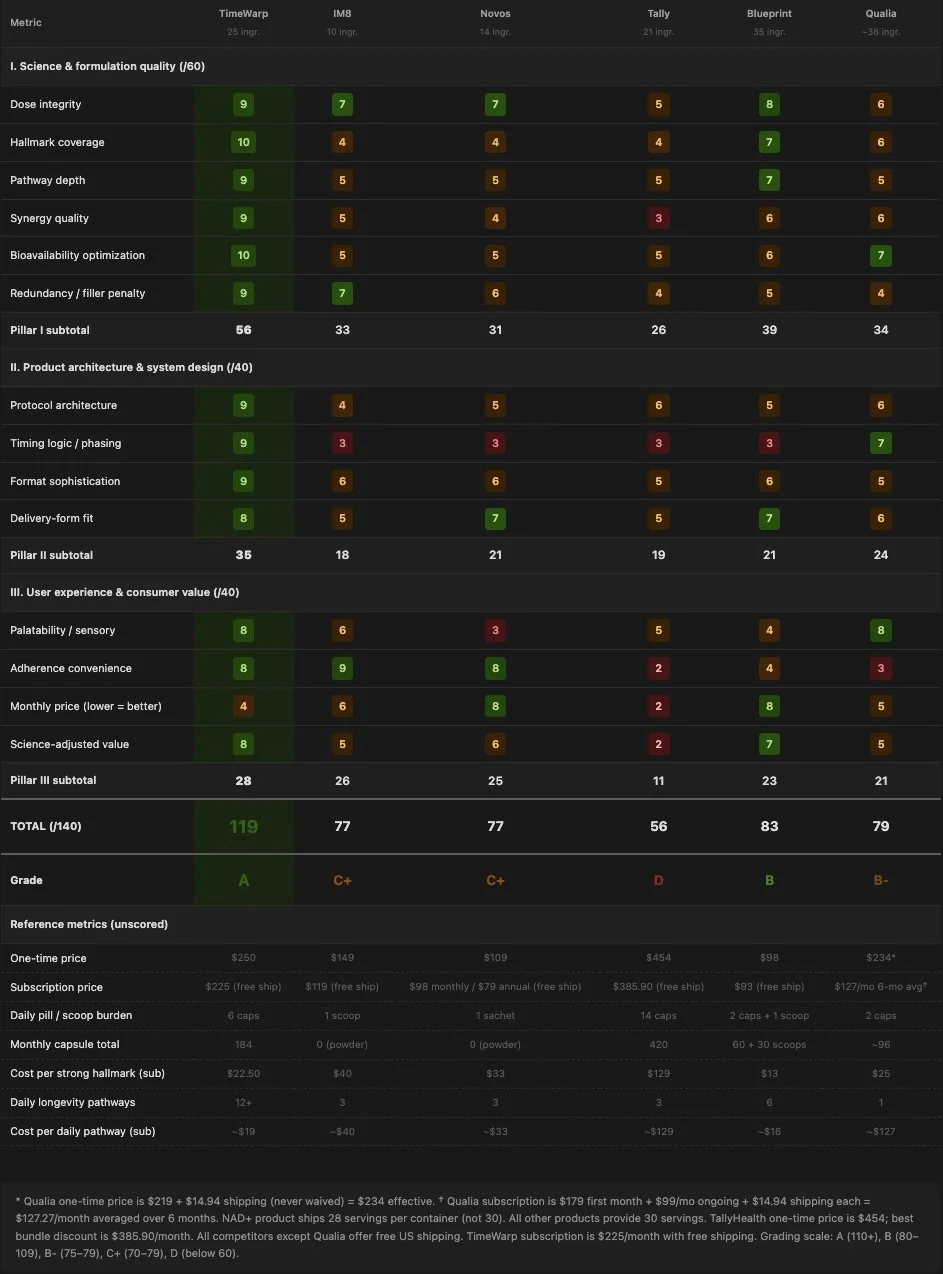
All-Up Scorecard
The 12-Hallmark Coverage Audit
Every formula in this comparison claims to address the 12 hallmarks of aging (López-Otín et al., 2023). We mapped every ingredient in every formula to specific hallmark mechanisms and rated coverage as Strong, Moderate, Weak, or Very Weak. The results reveal how far marketing claims diverge from formulation reality.
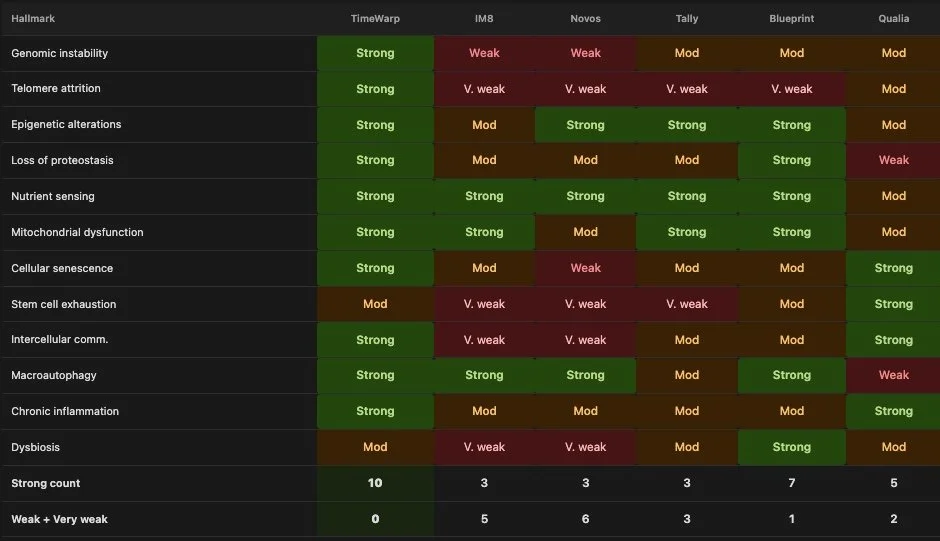
Hallmark Audit
Key Findings from the Hallmark Audit
Telomere attrition is TimeWarp's single biggest competitive moat. Four of five competitors rate "very weak" on this hallmark — they include no telomerase activator whatsoever. TimeWarp uses an astragalus root extract standardized to deliver 20mg of cycloastragenol, the bioactive telomerase-activating compound. This is the same methodology used by TA-65 (T.A. Sciences), the company that essentially created the telomerase-activating supplement category. Qualia is the only competitor that even attempts this hallmark, using crude Astragalus membranaceus root extract at 100mg in its Stem Cell product — but at roughly 0.05–0.1% cycloastragenol concentration, that delivers perhaps 0.05–0.1mg of the active compound. TimeWarp delivers 200–400x more of the telomerase-activating molecule. Despite having 35 ingredients, Blueprint has no telomere-targeted mechanism at all — a notable gap for a formula created by someone who claims to be reversing his biological age.
No competitor achieves zero gaps. Blueprint comes closest at 7 strong with 1 very weak (telomeres), but still leaves five hallmarks at moderate. Qualia has interesting spikes — best-in-class senescence coverage and the only dedicated stem cell product — but surprising holes in autophagy (no spermidine, no lithium) and proteostasis. IM8, Novos, and TallyHealth all cluster around 3 strong ratings with 5–6 hallmarks rated weak or absent. TimeWarp is the only formula with zero weak or very weak ratings.
The niacinamide-SIRT1 contradiction affects two brands. Both TallyHealth (1,000mg niacinamide in their NAD+ product) and Qualia (234mg niacinamide in their NAD+ product) include high-dose niacinamide alongside sirtuin activators like resveratrol. Niacinamide is a byproduct of sirtuin reactions and at high concentrations acts as a feedback inhibitor of SIRT1 — the very enzyme their resveratrol is supposed to activate. They are stepping on the gas and the brake simultaneously. TimeWarp avoids this entirely by using NMN, which feeds into NAD+ via the NMNAT pathway without accumulating the inhibitory nicotinamide intermediate at the sirtuin active site. This isn't a nuance — it's well-established in the sirtuins literature and represents a real formulation design error.
Spermidine dosing separates serious formulas from label decoration. TimeWarp (10mg) and Blueprint (10mg) use spermidine at doses aligned with the Eisenberg trial that showed cardiac benefits and autophagy induction. TallyHealth's 900mcg (0.9mg) is roughly 10x below effective threshold — it allows them to list "spermidine" on the label without delivering the mechanism. Qualia's daily product contains no spermidine at all, despite autophagy being a core hallmark.
Qualia's daily foundation is a single pathway. While Qualia's pulsed products (Senolytic and Stem Cell) are genuinely sophisticated, the daily NAD+ product — which the customer takes for 24+ days per month — contains just 300mg NR with a basic B-vitamin complex and 50mg resveratrol. That's one longevity pathway (NR → NAD+) running for 80% of the month. No daily autophagy support, no daily NRF2 activation, no daily inflammation management, no daily telomere support. TimeWarp runs 12+ mechanisms every single day. Aging doesn't pause on the days between Qualia's pulses.
Most formulas are "mitochondria + nutrient sensing + maybe autophagy" stacks. IM8, Novos, and TallyHealth all score Strong on nutrient sensing — these pathways (AMPK, mTOR, sirtuins) are the easiest to hit with common longevity compounds like berberine, resveratrol, and Ca-AKG. They all score Moderate or better on mitochondria. And then coverage drops off. Telomeres, stem cells, intercellular communication, genomic instability, and dysbiosis are consistently weak or absent. These are the hallmarks that require either uncommon ingredients (cycloastragenol), specific delivery technology (delayed-release capsules for sulforaphane), or deliberate architectural choices (pulsed senolytic protocols). TimeWarp's advantage is systematic coverage of the hallmarks that competitors skip.
Pillar I: Science & Formulation Quality — Deep Dive
This pillar carries the most weight in the analysis (6 metrics, /60) because formulation quality is the foundation everything else builds on. A beautifully packaged product with poor science is still a poor product.
Dose Integrity (TimeWarp 9, Blueprint 8, IM8 7, Novos 7, Qualia 6, TallyHealth 5)
This measures whether each ingredient hits a clinically validated dose — not just label presence, but therapeutic threshold. TimeWarp (9) lands nearly every ingredient at or above published effective doses: NMN at 350mg, Urolithin A at 500mg (matching the Mitopure trial dose), Ca-AKG at 1,000mg, Spermidine at 10mg. Curcumin at 100mg might appear low, but paired with 5mg piperine (which enhances curcumin bioavailability by roughly 2,000% per the Shoba et al. 1998 landmark study), the effective circulating dose is comparable to ~2,000mg of standard curcumin.
Blueprint (8) scores well with Ca-AKG at 2g (the highest in the comparison) and spermidine at 10mg, but glucoraphanin at only 20mg is roughly 7x below therapeutic NRF2 activation thresholds, and there's no myrosinase enzyme to convert it to active sulforaphane. TallyHealth (5) includes spermidine at 900mcg — approximately 10x below the effective dose — and the 1g niacinamide actively undermines the resveratrol in its own stack. Qualia (6) presents an interesting split: the pulsed Senolytic product has fisetin at 1,400mg (best-in-class, near Mayo Clinic trial dose), but the daily NAD+ product contains resveratrol at just 50mg — well below the 150–500mg range used in published studies — and 234mg niacinamide that inhibits SIRT1.
Hallmark Coverage Quality (TimeWarp 10, Blueprint 7, Qualia 6, IM8 4, Novos 4, TallyHealth 4)
Scored directly from the hallmark audit above. TimeWarp (10) achieves strong ratings on 10 of 12 hallmarks with zero weak or very weak ratings — the only formula in the comparison with no gaps. The two moderate ratings (stem cell exhaustion and dysbiosis) represent the hardest hallmarks to address in supplement form and are defensible given the current evidence landscape. Blueprint (7) is the next closest at 7 strong, though telomere attrition remains very weak — a notable omission given 35 ingredients and a founder who claims to be reversing his biological age. IM8, Novos, and TallyHealth all cluster at 4, each with 3 strong hallmarks but 5–6 hallmarks rated weak or absent. Every competitor that claims to cover "all 12 hallmarks" is verifiably stretching.
Pathway Depth (TimeWarp 9, Blueprint 7, IM8 5, Novos 5, TallyHealth 5, Qualia 5)
For each hallmark addressed, how many independent mechanisms support it? TimeWarp (9) stacks multiple mechanisms per hallmark: inflammation is addressed through four distinct pathways (curcumin via NF-κB, sulforaphane via NRF2 master switch, apigenin, and EGCG). Epigenetics has three mechanisms (5-MTHF + B12 + B6 for the complete methylation cycle, Ca-AKG as TET demethylase cofactor, pterostilbene for SIRT1 deacetylation). Nutrient sensing gets four-axis coverage (NMN for sirtuins, DHB for AMPK, Ca-AKG for mTOR modulation, pterostilbene for SIRT1). This metric also penalizes formulas where strong hallmark mechanisms only activate intermittently — Qualia (5) drops because its pathway depth is effectively 1 for 24+ days per month when only the daily NR product is being taken. Blueprint (7) maintains solid daily depth across its 6 active pathways, with particular strength in autophagy (spermidine + glucosamine + lithium) and proteostasis (spermidine + glutathione + glucosamine).
Synergy Quality (TimeWarp 9, Blueprint 6, Qualia 6, IM8 5, Novos 4, TallyHealth 3)
TimeWarp (9) has the most designed inter-ingredient synergies in the comparison. Piperine enhances curcumin absorption by 2,000%. Myrosinase enzymatically converts glucoraphanin to active sulforaphane — without the enzyme, the conversion is incomplete and highly variable between individuals. Apigenin inhibits CD38, a NAD+-consuming enzyme, thereby preserving the NAD+ that NMN generates (otherwise CD38 degrades NAD+ faster than NMN can replenish it). 5-MTHF + B12 + B6 form a complete methylation cycle where each component enables the next — a broken cycle (missing B12, for instance) means the entire methylation pathway underperforms. The Senolytic Cleanse sequences liposomal fisetin and isoquercetin (to induce apoptosis in senescent cells) followed by micro-encapsulated bromelain (to clear the resulting SASP debris and pro-inflammatory cascade).
TallyHealth (3) scores lowest because of a demonstrable anti-synergy: their NAD+ product contains 1,000mg niacinamide (a SIRT1 inhibitor) while their Vitality product contains 500mg resveratrol (a SIRT1 activator). These are sold and taken together as part of the same stack, producing a formulation contradiction where two products work against each other. Qualia (6) has excellent internal synergy within the Senolytic product (fisetin + quercetin phytosome + curcumin + piperlongumine hit four distinct senolytic pathways) but the daily product's 234mg niacinamide undermines its own 50mg resveratrol, and cross-product synergy between the three formulas is minimal.
Bioavailability Optimization (TimeWarp 10, Qualia 7, Blueprint 6, IM8 5, Novos 5, TallyHealth 5)
TimeWarp (10) earns the only perfect score in the analysis. Beyond liposomal fisetin, MaxiCuma curcumin, and dihydroberberine (3–5x better absorption than standard berberine with none of the GI distress), the Protect pill uses a delayed-release capsule specifically to protect sulforaphane formation. The glucoraphanin + myrosinase enzymatic conversion is acid-sensitive — myrosinase denatures in stomach acid, which is why most sulforaphane supplements fail to deliver the active compound. TimeWarp's delayed-release capsule bypasses the stomach entirely and releases in the small intestine where the conversion can proceed intact. This is the difference between the NRF2 mechanism working or not working. No competitor implements this level of pharmacological delivery design.
Additionally, the Senolytic Cleanse uses micro-encapsulated bromelain with a sequenced release design: liposomal fisetin and isoquercetin hit senescent cells first (inducing apoptosis), then the delayed-release bromelain arrives to clear the resulting SASP debris and pro-inflammatory cascade from the dying cells. Bromelain is a potent protease that degrades pro-inflammatory cytokines (IL-1β, IL-6, TNF-α) and fibrin deposits left behind by senescent cell clearance. Most senolytic protocols create a transient inflammatory spike as zombie cells die — TimeWarp's formulation is engineered to clean up after itself. No other formula in this comparison addresses the post-senolytic inflammatory response.
Qualia (7) uses Longvida curcumin and Quercefit quercetin phytosome in the Senolytic product — both premium bioavailability-enhanced forms with published absorption data. But these are only present in a product taken 2 days per month. The daily NAD+ product uses standard NR, standard resveratrol, and commodity B-vitamins with no bioavailability optimization whatsoever. Blueprint (6) uses ubiquinol (the reduced, more bioavailable form of CoQ10) and methylated B-vitamins, but standard fisetin and minimal glucoraphanin with no myrosinase co-factor. IM8, Novos, and TallyHealth (all 5) use largely commodity ingredient forms across the board.
Redundancy / Filler Penalty (TimeWarp 9, IM8 7, Novos 6, Blueprint 5, TallyHealth 4, Qualia 4)
TimeWarp (9) has the highest ingredient efficiency in the comparison: every one of 25 ingredients maps to at least one hallmark mechanism. Cofactors like B6, D3, K2, and magnesium bisglycinate serve specific biological roles — B6 completes the methylation cycle, K2 MK-7 directs calcium away from soft tissue (synergizing with D3), magnesium enables hundreds of enzymatic reactions including those involved in NAD+ metabolism. IM8 (7) is lean by necessity — 10 ingredients with minimal filler, though the powder format means some of those ingredients serve dual duty as flavoring agents.
TallyHealth (4) is the most padded relative to its hallmark output: L-theanine, choline, zinc, beta-glucan, and standard-RDA B-vitamins are general health ingredients spread across six products that deliver only 3 strong hallmark ratings. Blueprint (5) includes sodium hyaluronate (a skin/joint ingredient, not an aging pathway compound), L-lysine, L-theanine, and many B-vitamins at standard RDA levels that read more like a general multivitamin than a targeted longevity system. Qualia (4) has a yeast-culture B-complex, 50mg magnesium (12% DV), and 40mg coffeeberry in the daily NAD+ product — filler padding a 2-capsule format to look like a complete supplement when it's functionally just NR + niacinamide.
Pillar II: Product Architecture & System Design — Deep Dive
Great ingredients in a bad system underperform. This pillar evaluates whether the product is engineered as a coherent protocol or assembled as ingredients in a bottle.
Protocol Architecture (TimeWarp 9, TallyHealth 6, Qualia 6, Blueprint 5, Novos 5, IM8 4)
TimeWarp (9) is built as a biological operating system: three functionally segmented daily SKUs (Core for metabolic foundation and telomere support, Energize for mitochondrial function and NAD+ metabolism, Protect for NRF2 defense and inflammation pathways) plus a monthly Senolytic Cleanse pulse. Each SKU has a defined biological role, a branded color identity (marigold for Energize, black for Protect), and an ingredient grouping that reflects pharmacological logic rather than marketing convenience. The consumer understands why there are three pills because each one maps to a different layer of the aging framework.
Qualia (6) has clear product-level separation (NAD+ for daily energy metabolism, Senolytic for cell clearance, Stem Cell for renewal), but the daily product is architecturally hollow — it's a basic NR supplement, not the foundation of a multi-layered protocol. TallyHealth (6) has six named products with distinct positioning, but the separations are marketing-driven rather than pharmacologically motivated — why is taurine in "Sharpen" (brain) rather than "Amplify" (metabolism) when it has stronger metabolic data? Blueprint (5) requires combining two separate products in two entirely different formats (capsules + powder) with no unified delivery system connecting them. Despite being from the same brand, they function more like two products that happen to be sold together than an integrated protocol. IM8 (4) is a single product with no architectural logic beyond "everything in one scoop."
Timing Logic / Phased Design (TimeWarp 9, Qualia 7, all others 3)
Does the protocol differentiate between compounds that should be taken daily for chronic pathway support vs. compounds requiring high-dose pulsed exposure? The pharmacology is clear: senolytics need pulsed high-dose exposure to overwhelm the survival pathways of senescent cells. Daily low-dose fisetin at 100mg functions as a flavonoid antioxidant, not a senolytic — you need to cross a threshold of cellular stress that triggers apoptosis specifically in senescent cells without harming healthy ones. Similarly, stem cell mobilizers should be periodic (mimicking natural healing cycles) rather than chronic stimulation, which risks stem cell exhaustion — the very hallmark they're trying to address.
TimeWarp (9): Daily multi-pathway support across 12+ mechanisms, plus a dedicated monthly senolytic pulse at meaningful fisetin + isoquercetin doses with sequenced bromelain clearance. Two clean temporal layers with pharmacological rationale for each. The physical separation — daily sachet vs. monthly sachet — makes the two-tier protocol self-evident to the consumer. Qualia (7): Three temporal layers (daily NR, 2-day senolytic, 4-day stem cell), the most sophisticated pulsing design in the comparison. The deduction from a higher score reflects that the daily foundation between pulses runs on a single pathway. IM8, Novos, Blueprint, and TallyHealth all score 3: everything is daily with zero temporal differentiation. They include senolytic-adjacent ingredients (fisetin, quercetin) at chronic sub-threshold doses that deliver general anti-inflammatory effects at best, not senescent cell clearance.
Format Sophistication (TimeWarp 9, IM8 6, Novos 6, TallyHealth 5, Blueprint 5, Qualia 5)
TimeWarp (9): Color-coded pills where the consumer can physically see which functional pillar they're taking — marigold capsules for Energize, black capsules for Protect. Sachet-based unitized daily delivery for portability (one sachet = one complete daily dose). Delayed-release capsule technology on the Protect pill protecting acid-sensitive enzymatic conversion. A physically separate monthly pulse sachet that distinguishes the senolytic from the daily protocol. The consumer doesn't need to think — the format teaches them the system.
TallyHealth (5) gets credit for branded color-coding per SKU — each of the six products has a distinct visual identity, which is genuine design investment. But it wraps six separate standard capsule bottles that the consumer must manage independently. Blueprint (5) has a functional capsule/powder format split, but no color-coding, no delayed-release technology, no sachet unitization — just a generic capsule bottle and a powder tub that require two different consumption rituals every morning. Qualia (5) has three separate bottles with three different dosing schedules and no unified delivery system connecting them.
Delivery-Form Fit (TimeWarp 8, Blueprint 7, Novos 7, Qualia 6, IM8 5, TallyHealth 5)
Does the physical format match the pharmacology? TimeWarp (8): All 25 ingredients are capsule-appropriate concentrated actives — no ingredient requires powder-scale volume. The largest single-ingredient dose is Ca-AKG at 1,000mg, which fits comfortably across 2 capsules. Blueprint (7) and Novos (7): Both make smart format decisions. Blueprint splits bulk ingredients (creatine 2.5g, taurine 1.5g, glycine 1.2g, glutathione 250mg) into powder and concentrated compounds (NR 300mg, fisetin 100mg, lithium 1mg) into capsules. Novos correctly uses powder format for high-volume ingredients like 2g glycine and 1.2g magnesium malate. IM8 (5) compresses everything into powder, including compounds like dihydroberberine and fisetin that would be better protected from degradation and stomach acid in capsule form.
Pillar III: User Experience & Consumer Value — Deep Dive
The best longevity formula is the one you actually take every day for years. This pillar evaluates whether the product can sustain daily compliance and whether the science justifies the price.
Palatability / Sensory (TimeWarp 8, Qualia 8, IM8 6, TallyHealth 5, Blueprint 4, Novos 3)
This measures the physical experience of consumption — taste, texture, pill size, sensory comfort. Capsule-only formats score highest because swallowing capsules with water produces zero negative sensory experience. TimeWarp (8) and Qualia (8): Both are capsule-only on most days. TimeWarp's daily 6 capsules is a handful but entirely pain-free — no taste, no texture, no mixing. Qualia's daily 2 capsules is minimal. IM8 (6): The best-tasting powder in the comparison — consumer reviews describe it as "pleasant with a light sweetness and subtle chocolatey finish" and "remarkably refined, avoiding the swampy aftertaste common in green powders." But it's still a powder that must be mixed, tasted, and consumed over 30+ seconds — a fundamentally different sensory experience than swallowing capsules. TallyHealth (5): All capsules (no taste), but 14 pills in a single sitting creates its own physical discomfort — that much swallowing is unpleasant regardless of flavor neutrality.
Blueprint (4): The 2 daily capsules are fine, but the Longevity Mix powder has been described in consumer reviews as "God awful," "bitter and medicinal," and "hard to swallow." The blood orange flavor attempts to mask 14.8g of powder containing inherently bitter compounds (creatine, taurine, glutathione), but multiple reviewers report the taste is a problem. Novos (3): The unflavored powder is nearly undrinkable. The orange version is tolerable but far from enjoyable, with the bitter/metallic taste of magnesium malate and Ca-AKG poorly masked. Multiple users report developing anticipatory aversion — dread before the daily ritual — which is a proven adherence killer. When a consumer starts having anxiety about taking a supplement, compliance drops within weeks regardless of how well the formula is designed.
Adherence Convenience (IM8 9, TimeWarp 8, Novos 8, Blueprint 4, Qualia 3, TallyHealth 2)
IM8 (9): One scoop, one drink, done. Lowest possible friction. Novos (8): One sachet, nearly identical logistics to IM8 — scored slightly lower because taste-driven compliance risk undermines the format's simplicity. TimeWarp (8): Six capsules from one daily sachet — open, swallow, done. No mixing, no prep. Plus 2 capsules on 2 days per month for the senolytic pulse. Very low friction with a simple monthly event.
Blueprint (4): Two capsules AND a 14.8g powder scoop that needs mixing every morning — two distinct consumption rituals, two different product formats, every single day. The capsule bottle and powder tub sit separately in your kitchen with no unified delivery system. This is meaningfully more friction than a single-format protocol. Qualia (3): Three separate bottles with three different dosing schedules. A Qualia customer's month looks like this: Days 1–4: take 2 NAD+ caps + 6 Stem Cell caps (8 pills). Days 5–14: take 2 NAD+ caps only. Days 15–16: take 2 NAD+ caps + 6 Senolytic caps (8 pills). Days 17–30: take 2 NAD+ caps only. That's three distinct daily regimens within a single month requiring calendar tracking. When does the stem cell phase start? When does the senolytic phase fall? The moment you miss a day or lose track of which phase you're in, the entire pulsing logic breaks down. TallyHealth (2): 14 capsules daily across 6 separate bottles — 420 capsules per month. The consumer opens six different containers every morning, counts out different quantities from each (4 Vitality, 3 Amplify, 3 Restore, 2 Sharpen, 2 Defend, 2 NAD+), and manages six separate refill timelines. For comparison, TimeWarp is one sachet containing 6 color-coded capsules.
Monthly Price — lower is better (Blueprint 8, Novos 7, IM8 5, Qualia 5, TimeWarp 4, TallyHealth 2)
All prices shown are one-time purchase; subscription savings noted where available. Blueprint ($98 one-time / $93 sub) and Novos ($109 one-time / $98 monthly sub / $93 6-month / $79 annual) are the most affordable. IM8 ($149 one-time / $119 sub) follows. Qualia's pricing is unusually structured: $219 one-time plus $14.94 shipping (never waived) = $234 effective; subscription starts at $179 first month then $99 ongoing, plus $14.94 shipping each time, averaging $127/month over 6 months including shipping. TimeWarp ($250 one-time / $225 sub with free shipping) is premium. TallyHealth ($454 one-time / $385.90 best bundle price, free shipping) is the most expensive in the comparison by a wide margin. All competitors except Qualia offer free US shipping.
Science-Adjusted Value (TimeWarp 8, Blueprint 7, Novos 6, IM8 5, Qualia 5, TallyHealth 2)
The metric that reframes the pricing conversation. Cost per strong hallmark at subscription pricing tells you what you're actually paying per unit of formulation quality delivered:
Blueprint leads at $13 per strong hallmark (7 strong at $93/month sub) — the best raw ratio in the comparison. But this number comes with caveats: those 7 hallmarks don't include telomeres (completely missing), and NRF2 coverage is compromised by only 20mg glucoraphanin with no myrosinase. You're getting a good daily foundation cheaply, but with blind spots. TimeWarp follows at $22.50 per strong hallmark (10 strong at $225/month sub) — more complete coverage at a competitive per-mechanism price. Novos is $33 (3 strong at $98 monthly sub). IM8 is $40 (3 strong at $119 sub). Qualia is $25 (5 strong at $127/month 6-mo average including shipping). TallyHealth is worst at $129 per strong hallmark (3 strong at $386) — a customer pays more than 5x what a TimeWarp customer pays per strong hallmark, and they only get 3 of them.
An even more revealing metric is cost per daily-active pathway — what you pay for each longevity mechanism running every day: TimeWarp at ~$19/pathway, Blueprint at ~$16/pathway, Novos at ~$33/pathway, IM8 at ~$40/pathway, TallyHealth at ~$129/pathway, and Qualia at ~$127/pathway. Qualia's daily pathway cost is so high because their $127/month subscription runs just 1 daily pathway (NR → NAD+) for 80% of the month. The pulsed products are excellent, but aging doesn't pause between pulses.

Tally Health Call Out
Company-by-Company Analysis

Blueprint Score
Score: 83/140. Blueprint is the most architecturally interesting competitor — and the closest thing to a genuine daily longevity foundation outside of TimeWarp. The formula has real strengths: spermidine at 10mg (a legitimate autophagy dose, not the 0.9mg decoration TallyHealth uses), Ca-AKG at 2g (the highest dose in the comparison), L-glutathione at 250mg (a differentiator no other competitor includes), Lactobacillus acidophilus at 4 billion CFU (the only actual probiotic in any formula here, giving Blueprint the best dysbiosis coverage in the set), and NR at 300mg. Bryan Johnson's radical transparency — publishing third-party Certificate of Analysis results for every batch — sets an industry standard that other brands should follow.
The B grade reflects genuine formulation quality tempered by structural limitations. Despite 35 ingredients across two products, Blueprint completely misses telomere attrition (rated very weak) — there is no telomerase activator, no cycloastragenol, no astragalus extract of any kind. For a protocol created by someone who claims to be reversing his biological age, leaving an entire hallmark of aging unaddressed is a notable gap. The two-product, two-format structure (capsule bottle + powder tub) creates daily friction — the consumer manages two separate consumption rituals every morning. The capsule/powder split is pharmacologically logical (bulk compounds in powder, concentrated actives in capsules), but there's no sachet unitization, no color-coding, and no physical system connecting the products into a unified protocol. Glucoraphanin at only 20mg with no myrosinase enzyme means their NRF2 activation is largely theoretical — sulforaphane conversion at that dose is minimal. And everything is daily with zero timing differentiation: no pulsed senolytic, no phased design.
Blueprint is what happens when a well-funded team optimizes for evidence density — include ingredients with the most published studies — without designing them into a coherent multi-pathway system with temporal logic. At $98 one-time / $93 subscription, it's the strongest value proposition for someone who wants a solid daily foundation. But it's a well-built multivitamin-plus, not a systems-engineered longevity protocol.

Qualia Score
Score: 79/140. Qualia is a tale of two companies. The team that built the Senolytic and Stem Cell products understands longevity pharmacology at a sophisticated level — pulsed dosing protocols, premium bioavailability forms (Longvida curcumin, Quercefit quercetin phytosome), multi-mechanism pathway targeting, and the only dedicated stem cell product in this comparison (with AFA blue-green algae, royal jelly, nucleotides, and astragalus). The Senolytic product — fisetin at 1,400mg with quercetin phytosome at 750mg, curcumin at 400mg, piperlongumine at 50mg, and luteolin at 150mg, taken over 2 days — is the most potent consumer senolytic formula available, approaching Mayo Clinic trial-grade dosing.
Then there's the daily product. Qualia NAD+ is 2 capsules containing 300mg NR, 234mg niacinamide, 50mg resveratrol, 40mg coffeeberry, a standard B-vitamin complex from yeast culture, and 50mg magnesium (12% DV). For 24+ days per month — the days between pulsed interventions — this is the only product the customer takes. One longevity pathway (NR → NAD+), with an internal contradiction (niacinamide inhibiting the SIRT1 that resveratrol is supposed to activate), in a format padded with filler.
The calendar complexity is also a problem. Three bottles, three dosing schedules, three distinct daily regimens within a single month. Days 1–4 you take 8 pills. Days 5–14 you take 2. Days 15–16 you take 8 again. Days 17–30 you take 2. This requires calendar tracking, and any disruption collapses the pulsing logic. Additionally, the NAD+ product ships with 28 servings per container — not 30 — meaning customers either skip 2–3 days per month or need ~13 bottles per year instead of 12. And shipping is $14.94 per order, never waived — adding ~$180/year to the true cost that every other competitor in this comparison absorbs.
Pricing is unusually structured: $219 one-time ($234 including shipping), or a subscription that starts at $179 for the first month and drops to $99 ongoing — plus $14.94 shipping each time. Averaged over 6 months, the effective cost is $127/month including shipping. The step-down creates a confusing price signal where the first month feels expensive ($194 out the door) and may drive churn before customers reach the lower ongoing rate.
Qualia has the best senolytic on the market and a genuine (if evidence-thin) stem cell attempt. But a protocol that runs on one daily pathway for 80% of the month, with a formulation contradiction in the daily product and calendar gymnastics required for compliance, doesn't justify B+ territory.

IM8 Longevity Score
Score: 77/140. IM8 is the AG1 of longevity — maximum convenience, strong marketing, and a celebrity co-founder driving rapid adoption. The business execution is impressive: from launch in December 2024 to $6.6M monthly revenue by September 2025, reaching 350,000+ customers and 10M+ servings. The product is NSF Certified for Sport, third-party tested, and available in an açaí pomegranate powder format that reviewers describe as the best-tasting in the longevity category.
But the formula is a 10-ingredient stack targeting roughly a quarter of the aging framework. The three strong hallmarks (nutrient sensing via NMN + DHB + resveratrol, mitochondrial support via NMN + PQQ + taurine + astaxanthin, and macroautophagy via spermidine + DHB) are legitimate. Everything else is moderate, weak, or absent. No telomerase activator. No NRF2 activation system. No methylation cycle. No senolytic protocol. No intercellular communication coverage. No dysbiosis support. At 10 ingredients in a single daily powder with no timing differentiation, there's only so much mechanistic coverage available. IM8's value proposition is simplicity and compliance, not comprehensive hallmark coverage.

Novos Score
Score: 77/140. Novos has the best clinical evidence of any competitor — and perhaps any longevity supplement on the market. An 18% lifespan extension in aged mice (surpassing all other tested supplements in the Newcastle University study), a human DunedinPACE trial showing 73% of users slowed biological aging pace with p=0.001, and a formulation team from Harvard Medical School and MIT. The science positioning is legitimate.
But the formula has structural gaps that the clinical data can't paper over. No NAD+ precursor of any kind — no NMN, no NR. No telomerase activator. Fisetin at only 100mg daily (sub-senolytic). No pulsed intervention layer. Their epigenetic coverage is genuinely strong (glycine + Ca-AKG + pterostilbene + lithium is a four-mechanism stack), their autophagy axis works (glucosamine + lithium + pterostilbene), and their nutrient sensing is solid (Ca-AKG + pterostilbene + glucosamine's hexosamine pathway). But 9 of 12 hallmarks are moderate, weak, or absent.
The taste is a serious adherence problem. The unflavored powder is nearly undrinkable; the orange version is tolerable but produces anticipatory aversion in some users — a dread response that kills compliance within weeks. At $109 one-time ($98 monthly sub, as low as $79 annual) it's the strongest science-per-dollar at the budget price point, but the question is whether "good at three hallmarks" is enough when aging operates across twelve.

Tally Health Score
Score: 56/140. TallyHealth is the starkest example in this comparison of brand premium over substance. The Sinclair name commands a pricing premium that the formulation doesn't support. At ~$386/month for the full 6-product stack, it's the most expensive offering by 54% — and the lowest-scoring by a margin of 21 points.
TimeWarp leads on all 15 metrics. TallyHealth does not score higher or equal on a single dimension. The closest gap is format sophistication (5 vs 9), where TallyHealth invested in branded color-coding per SKU — genuine design work. But TimeWarp does the same at the pill level (marigold Energize, black Protect) while also adding delayed-release capsule technology, micro-encapsulated bromelain for sequenced senolytic clearance, and sachet-based unitized delivery. Even on their strongest relative metric, TallyHealth trails by 4 points.
The formulation contradiction is the most damaging finding: 1,000mg niacinamide (SIRT1 inhibitor) taken alongside 500mg resveratrol (SIRT1 activator) in the same daily stack. The pill burden (420 capsules/month across 6 bottles, 14 per day) is the highest by far. Spermidine at 900mcg is 10x below therapeutic threshold. And the cost per strong hallmark — $129 — is 5x worse than TimeWarp's $25.
Credit where it's due: their epigenetic hallmark coverage is strong (complete methylation cycle + Ca-AKG + resveratrol), and the TallyAge epigenetic test is a legitimate biological age measurement tool that could add real value to any longevity protocol. Their reported clinical outcome (62% of members lowered epigenetic age by 2+ years) is meaningful — but that result comes from the test + lifestyle Action Plan + Vitality supplement combined, not from the full 6-product stack.
Conclusion: What the Scorecard Reveals
Three structural patterns emerge from this analysis:
Ingredient count does not predict quality. TimeWarp achieves 10 strong hallmarks with 25 ingredients. Qualia achieves 5 with ~38. Blueprint achieves 7 with 35. TallyHealth achieves 3 with 21 across 6 products. The formulas with the most ingredients tend to have the most filler — standard B-vitamins, general antioxidants, and feel-good compounds that don't address aging pathways. The question isn't how many ingredients are on the label; it's how many are doing mechanistically specific work at clinically validated doses.
Architecture matters as much as ingredients. The gap between TimeWarp and the field isn't just about having better ingredients — it's about how those ingredients are organized into a system. Color-coded capsules that teach the consumer the protocol. Delayed-release technology that protects acid-sensitive enzymatic conversions. A pulsed monthly senolytic with sequenced anti-inflammatory clearance. A daily/monthly temporal structure that matches the pharmacology of each intervention type. These are product design decisions that no ingredient list can capture.
The best longevity supplement is the one that works at every level. The right molecules, at the right doses, in the right delivery forms, on the right schedule, in a format the consumer will actually use every day for years. TimeWarp Protocol 01 is the only formula in this comparison that addresses all five of those requirements simultaneously. That's why it scores 119 out of 140 while the field clusters between 56 and 82.
Methodology notes: All ingredient data sourced from supplement facts panels on official brand websites or product packaging. Prices reflect subscription rates where available as of early 2026 and are normalized to 30-day supply. Hallmark coverage ratings are based on published mechanism-of-action literature for each ingredient at the specific dose listed. The scoring framework was developed independently of any brand and applies consistent criteria across all products evaluated. The grading scale is: A (110+), B- (75–109), C+ (70–79), C (60–69), D (below 60), curved to this competitive set.
Appendix A: Complete Formula Listings
Every ingredient, every dose, every product — as listed on the supplement facts panels reviewed for this analysis.
TimeWarp Longevity Protocol
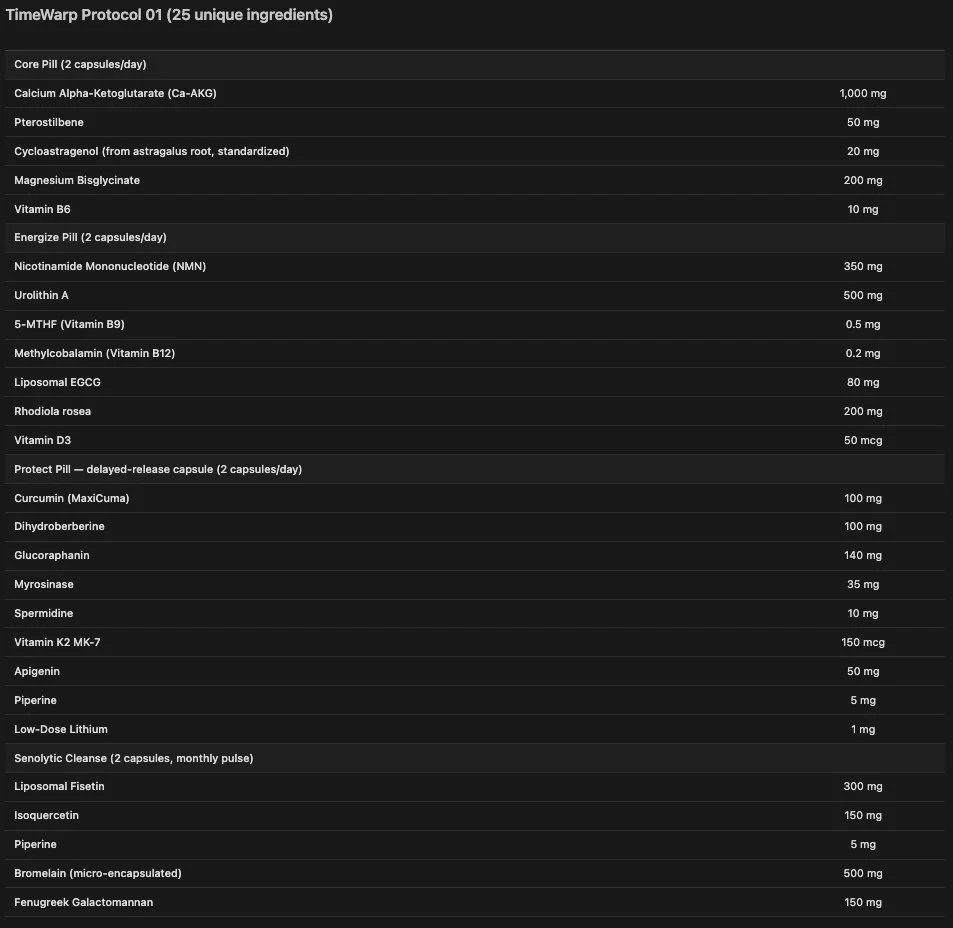
TimeWarp Longevity Protocol Formula
IM8 Daily Ultimate Longevity
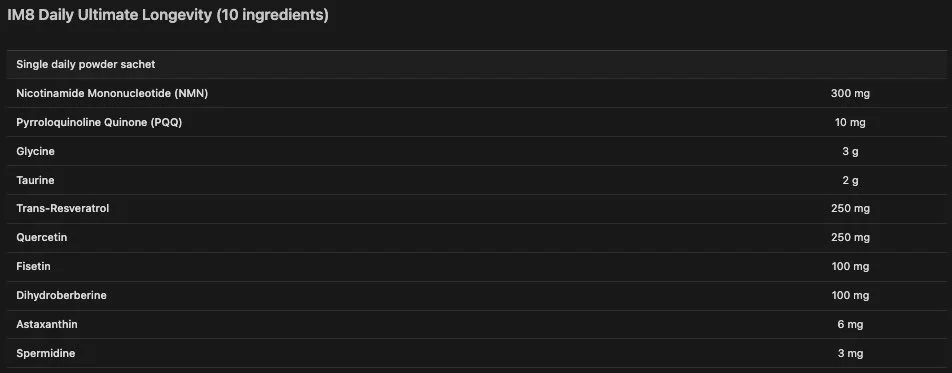
IM8 Longevity Formula
Novos Core
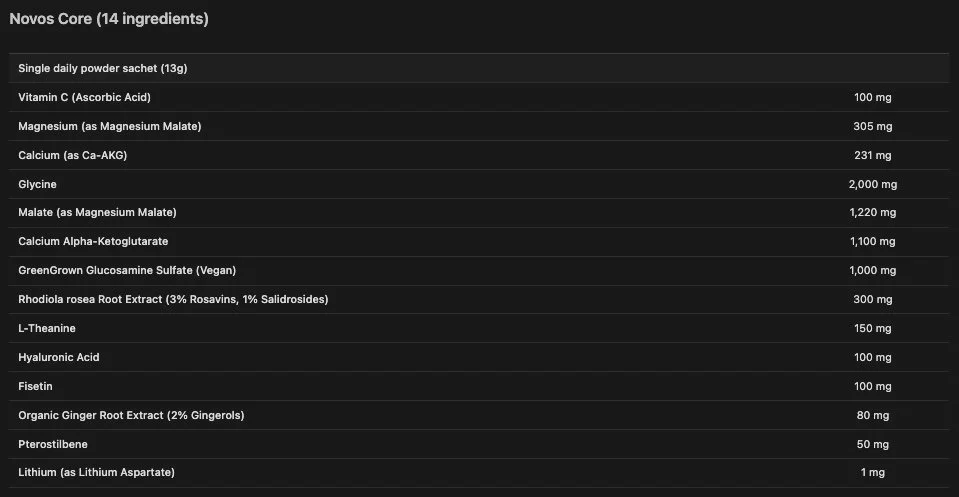
Novos Core Formula
Tally Health Full Stack
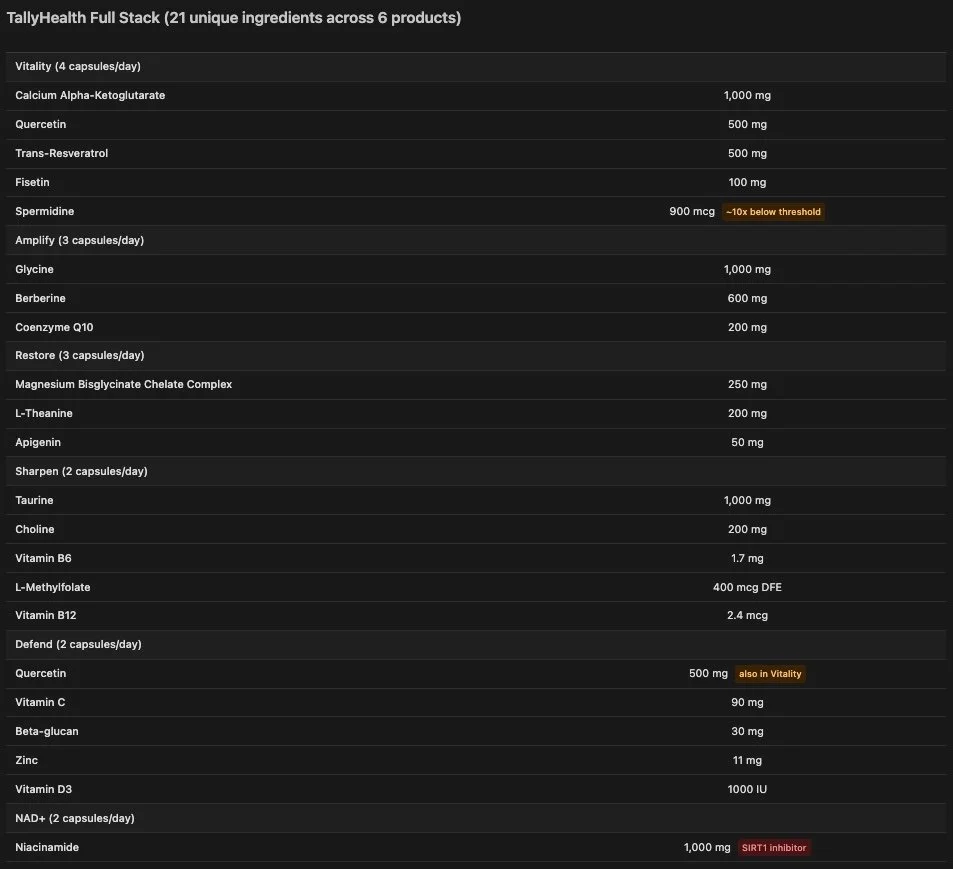
Tally Health Formula
Blueprint Essential Capsules + Longevity Mix
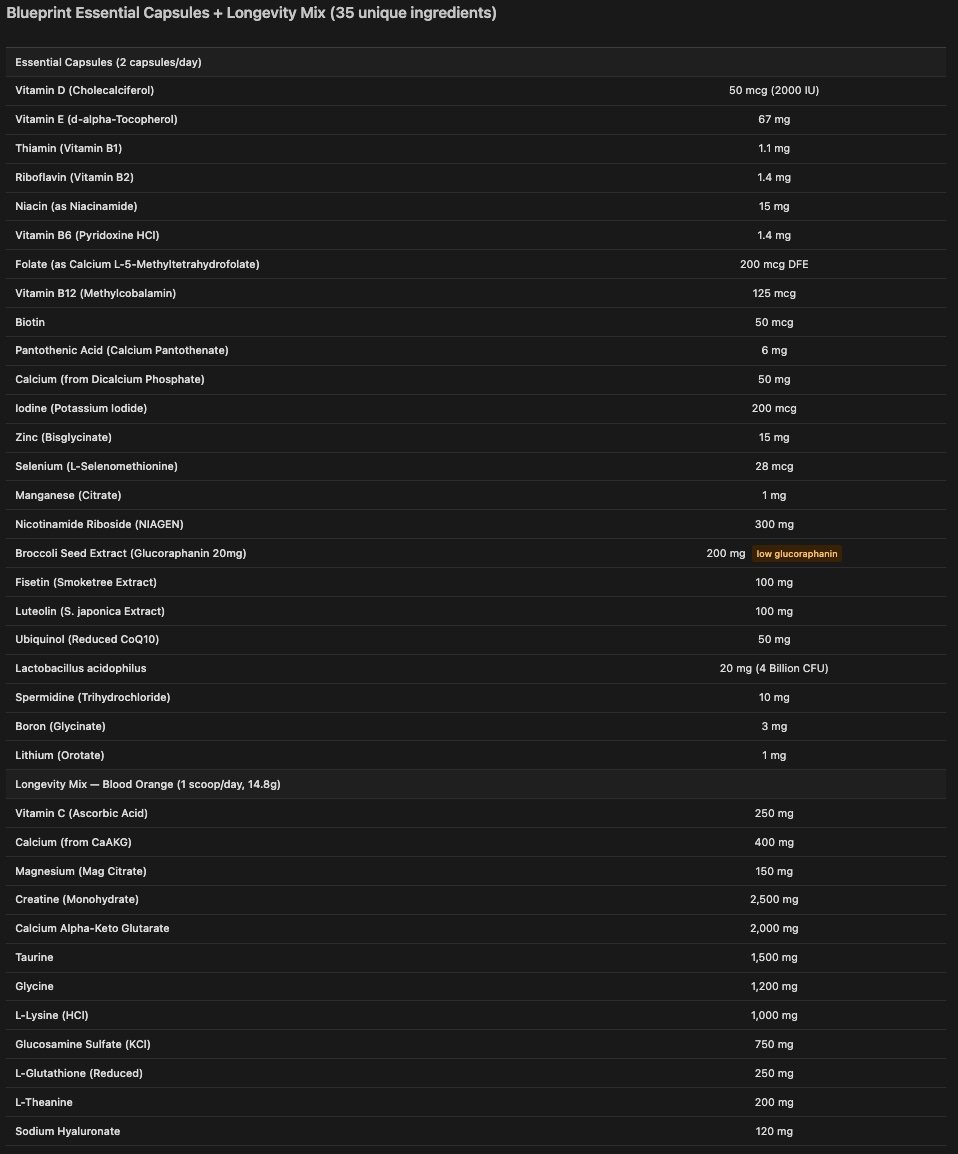
Blueprint Longevity Formula
Qualia Longevity Bundle
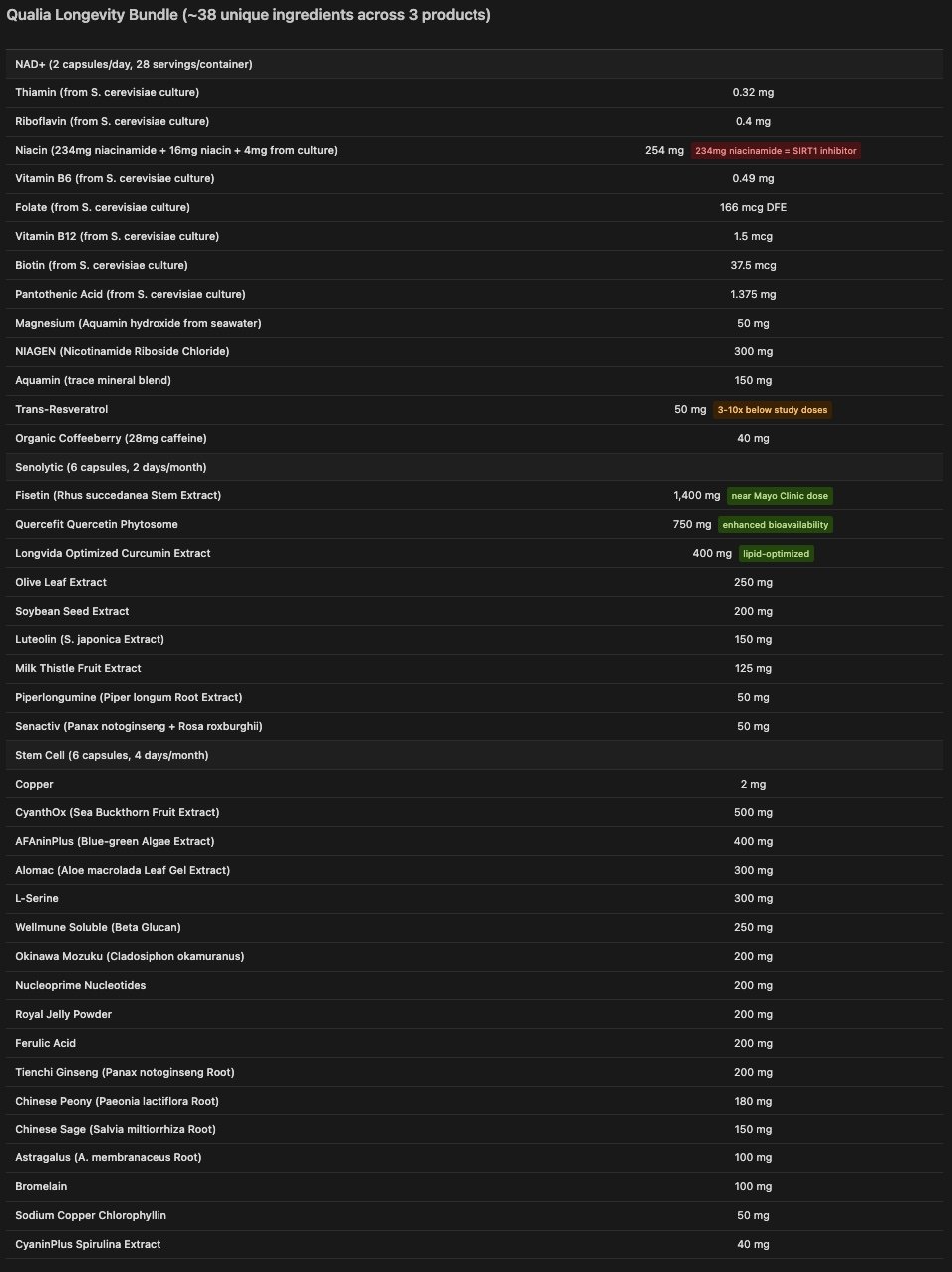
Qualia Longevity Formula
Appendix B: Competitor Pricing Deep Dive
One-time, subscription tiers, effective monthly cost, shipping, and discount structure — all normalized to 30-day supply.
Master Pricing Table
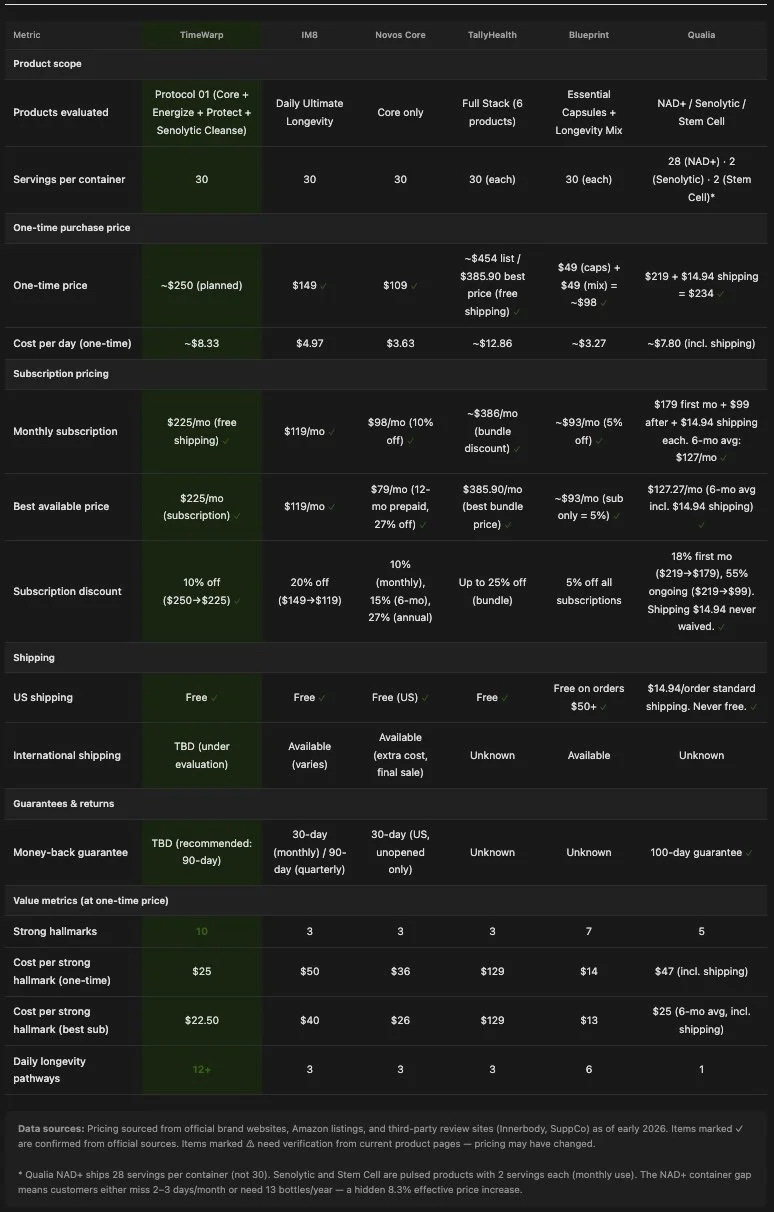
Master Price Comparison Matrix
Subscription Tier Breakdown
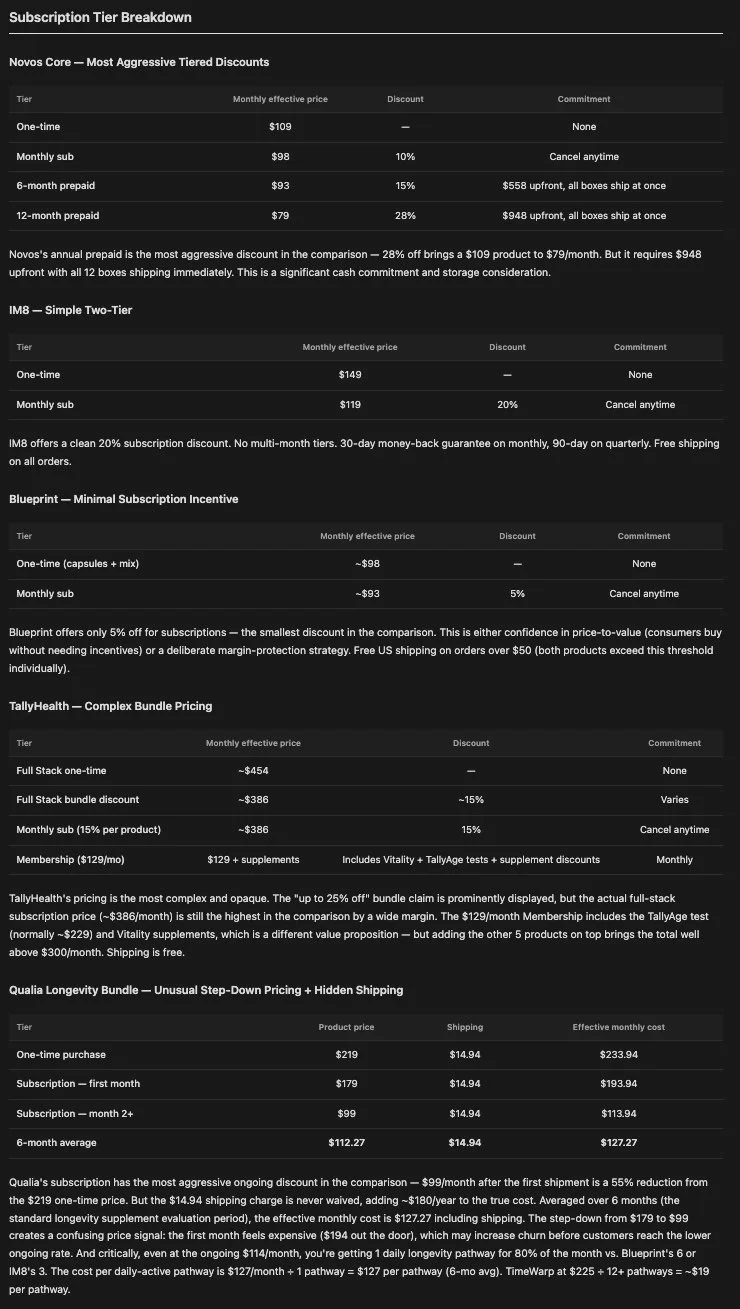
Subscription comparison
